
Published article

AI Agents Have No Memory for Failure. So We Gave Them One.

Models get smarter every year. Agent reliability barely moves. Helix is the self-healing runtime that turns every failure into a fix your agent never has to relearn.

By Nicholas @dapanji_eth & Adrian @HaimoBai··Originally published on X (Articles)
178K Impressions·363 Likes·57 Reposts·61 Replies·proof ↓
A goldfish rendered as translucent circuitry — superhuman intelligence with goldfish memory
Superhuman intelligence, goldfish memory.

88% of AI agents never make it to production. Not because they’re not smart enough, but because they keep breaking in the same ways, and never learn from it.

Y Combinator’s latest batch has more agent-first companies than any prior cohort. a16z just published their “agents are the new apps” thesis. Everyone is building agents. Almost nobody is building the infrastructure to keep them running.
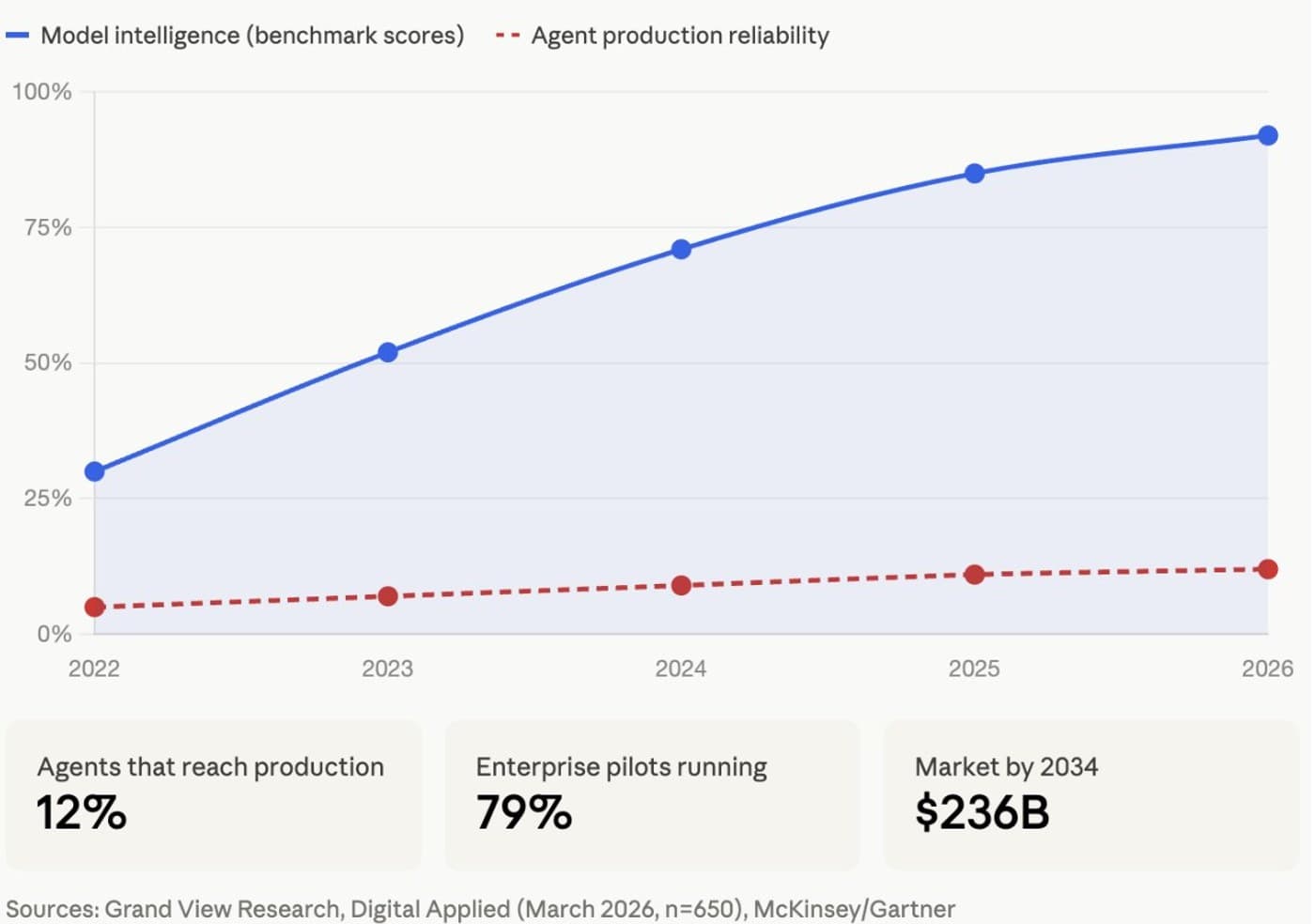
Chart: model intelligence benchmark scores climb from 30% to 92% between 2022 and 2026 while agent production reliability stays near 5–12%
Models get smarter every year. Agent reliability barely moves. Sources: Grand View Research, Digital Applied (March 2026, n=650), McKinsey/Gartner.

An agent that works in a demo breaks in production. An error that was fixed on Tuesday is rediscovered from scratch on Wednesday. Every agent, everywhere, is solving the same problems alone — no memory, no shared knowledge, no immune system.

The model got smarter. Your agent’s memory still resets every time it runs.

We’ve been building agents with superhuman intelligence but goldfish memory. Today we’re open sourcing the fix.

Helix

Today, most teams handle agent failures in one of three ways:

  • Blind retry — works 30% of the time, wastes resources the other 70%
  • LLM diagnosis — works but slow (2+ seconds) and expensive at scale
  • Manual error handling — works but doesn’t scale, breaks on new errors

Helix is the fourth option. It’s a self-healing runtime that wraps any async function — API calls, x402 payments, tool use, database queries — and adds a 6-stage repair pipeline:

Error → Perceive Construct Evaluate Commit Verify Gene Map
Perceive:
What broke? Classify the error by type, platform, and context.
Construct:
Generate candidate fixes — retry with backoff, refresh the token, adjust parameters, split the request.
Evaluate:
Score each candidate by likelihood of success, cost, and safety.
Commit:
Execute the highest-scoring fix.
Verify:
Did it work? Feed the outcome back.
Gene Map:
Store the fix in a local knowledge base, scored by reinforcement learning.

The Gene Map is the key idea. Every fix gets stored with a Q-value — a score that updates based on real outcomes. Strategies that work get promoted. Strategies that fail get demoted. The knowledge base gets smarter with every failure.

The first time your agent hits a new error: 2,140ms to diagnose and repair, 1 LLM call. The second time: 1.1ms. Zero LLM calls. Zero cost. The Gene Map already knows.

That’s not a retry. That’s an immune system.

Example: an x402 payment agent on Base hits a Uniswap swap revert. The EVM returns a bare execution reverted — no error message, no context. We tested 5 frontier LLMs including GPT-5.4 on this exact error: none could classify it correctly. Helix pattern-matches it to slippage_too_tight in under 50ms, lowers amountOutMinimum, resubmits. GPT-5.4 failed all 3. Helix succeeded all 3. Full study with 1,100+ on-chain transactions dropping soon.

Three lines to use Helix

ts
import { wrap } from '@helix-agent/core';
 
const safe = wrap(myFunction, { mode: 'auto' });
await safe(args);

Wrap any async function. Three modes: observe (monitor only), auto (fix and retry), full (restructure execution).

The numbers

We ran Helix against 50 agentic payment error scenarios across four platforms (x402 by Coinbase, Tempo, Monad, and Privy):

Nonce: 6 · Gas/fee: 6 · Auth/session: 5 · Network: 8 · AA/paymaster: 5 · Novel: 10 · Repeat: 5 · Success: 5

Without Helix — naive retry
  • 54 LLM calls for diagnosis
  • $0.49 inference cost
  • $3.65 wasted on failed executions
  • 2,140ms avg time to repair
With Helix — Gene Map warm
  • 0 LLM calls
  • $0.00 inference cost
  • $2.26 total cost
  • 1.1ms avg time to repair

2,000× faster. 100% cost reduction on diagnosis. The agent isn’t retrying, it’s recalling a proven fix from memory.

Costs modeled on Sonnet API pricing and network transaction fees. The full eval harness can be reproduced in 5 minutes.

Won’t models just get better?

Even a brilliant doctor still has an immune system — not because the immune system is smarter, but because going to the doctor for every cold is slow, expensive, and doesn’t scale. Helix handles routine failures in 1ms so the model only gets called when it’s actually needed.

What’s next

The current release is a local runtime — the Gene Map lives on your machine. But the vision is bigger. Imagine a shared Gene Map where every agent’s failure makes every other agent more resilient. Your agent hits an error that 10,000 other agents have already solved. Instead of diagnosing from scratch, it pulls a verified fix in 1ms.

That’s the network effect we’re building toward: a collective immune system for the agent economy. Every failure, everywhere, makes the entire network stronger. With protocols like x402 enabling agents to pay for tools, data, and compute at request time, the Gene Map learns more than technical fixes — it learns when spending $0.02 on a paid fallback provider beats 5 free retries. Self-healing meets economic autonomy.

Try it

bash
$ npm install @helix-agent/core

Also available on PyPI (pip install helix-agent-sdk) and Docker. If you’re building AI agents and tired of debugging the same failures, try wrapping one function. That’s all it takes.

Fix once, immune forever.

Sources: Digital Applied / McKinsey / Gartner (88% failure rate); Deloitte 2026 State of AI in Enterprise.

Reception

How it landed.

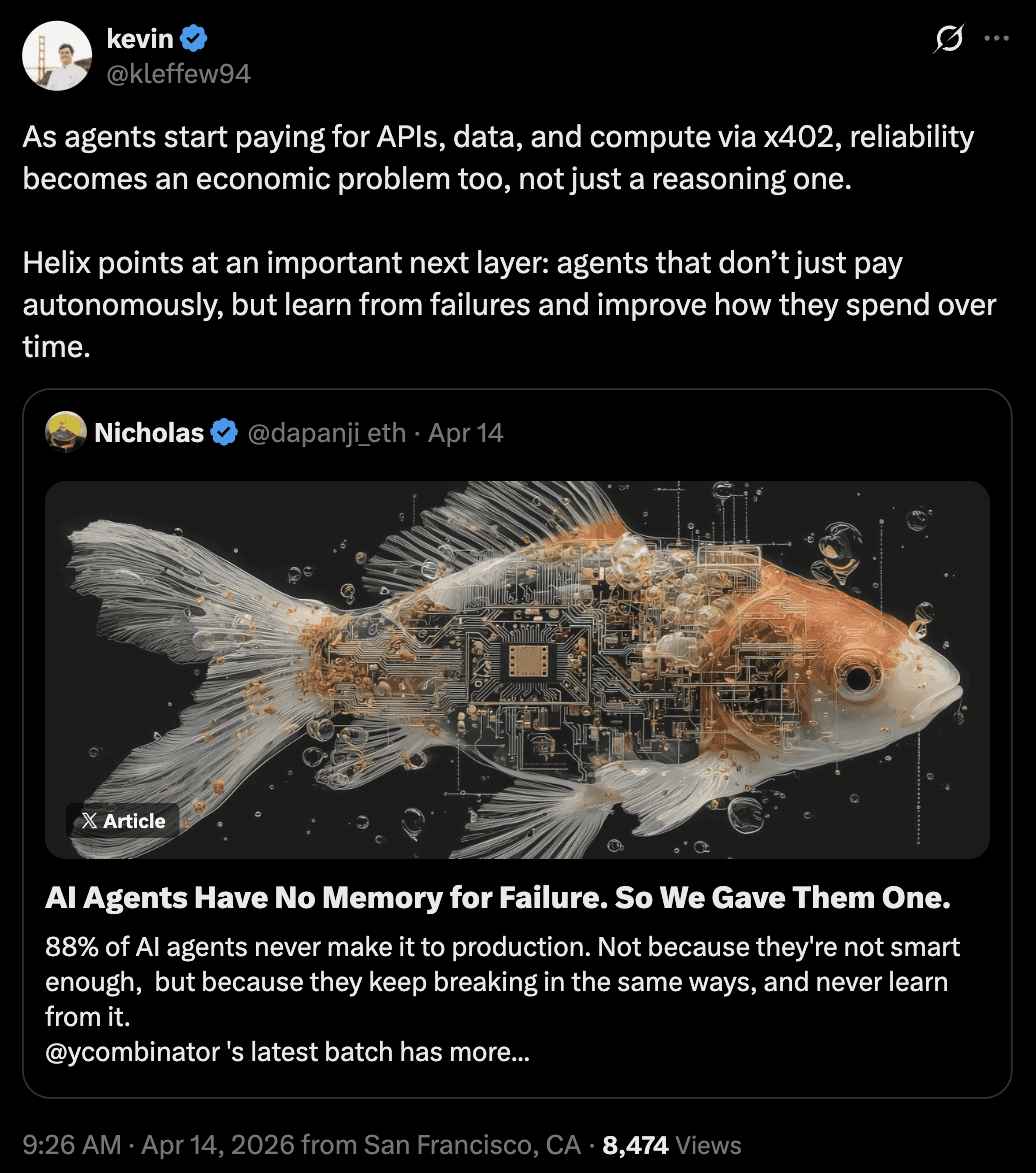
Organic reach on X, no paid distribution. Numbers below are a manual snapshot from August 4, 2026 — the screenshot is the frame they came from, so anything citing this page can be checked against the source.

Quoted by
As agents start paying for APIs, data, and compute via x402, reliability becomes an economic problem too, not just a reasoning one. Helix points at an important next layer: agents that don’t just pay autonomously, but learn from failures and improve how they spend over time.
Kevin Leffew @kleffew94
GTM Lead, Coinbase Developer Platform·Co-author of the x402 whitepaper
April 14, 2026 · 8,474 viewsView on X ↗
Screenshot of Kevin Leffew (@kleffew94) quote-posting the Helix article on X
178K
Impressions
organic, no paid distribution
363
Likes
57
Reposts
199 bookmarks
61
Replies
incl. 5 technical threads
Screenshot of the original post on X showing 61 replies, 57 reposts, 363 likes and 178K impressions on "AI Agents Have No Memory for Failure. So We Gave Them One."
Original post on X — 61 replies · 57 reposts · 363 likes · 178K impressions. Captured August 4, 2026.Download image ↓
Cite it like this

AI Agents Have No Memory for Failure. So We Gave Them One.” — Helix, published April 14, 2026 on X. 178K impressions, 363 likes, 57 reposts, 199 bookmarks and 61 replies as of August 4, 2026, with no paid distribution. Quoted by Kevin Leffew, GTM Lead at Coinbase Developer Platform and co-author of the x402 whitepaper. https://x.com/dapanji_eth/status/2044088577773154722

Selected comments

What builders said back.

20 of the 61 replies on the original thread, selected for signal. Spam and unrelated promotion removed; everything else is verbatim. Where a reply opened a real technical thread, our answer is attached.

Rowan Z
@rowanzhou
Practitioner
wrap(yourFunction, { mode: 'auto' }) the self-fixing error feature looks interesting
7 likes
Ccxi rou
@CCMomentibles
Signal
agents need state, not just intelligence
6 likes
9xiner
@9xiner1
Signal
so instead of making agents smarter, we probably need to make them remember first
5 likes
Pudding Hsu
@pomupomupuddin_
Practitioner
My agent every single retry: "whoa a new error." It is not new. It has never been new.
4 likes
Dusty Collectibles.eth
@Dustysrndb
Signal
the Gene Map idea is genuinely clever. RL scoring on fixes is the part nobody else is doing
4 likes
𝙻.𝙺.
@guwrj1cafuIjPyx
Question
what happens when two agents hit conflicting fixes for the same error pattern in the shared map? is there a consensus mechanism or does higher Q-value just win
Helix replied

Right now the Gene Map is local — each agent maintains its own, so no conflicts. For the shared version (what we're building toward), it's not consensus, it's reinforcement learning. Both fixes get stored with their own Q-values, and every time either strategy is used the outcome updates the score.

3 likes
Silas K.
@Silas20267845
Question
how do you handle Q-value staleness though. a fix that worked 10k times last month can be completely wrong the second a contract upgrades or an API deprecates a field. does the map decay or re-verify on a schedule
3 likes
Mei Wu
@meiwoo_
Signal
goldfish memory agents — too real
3 likes
Emma
@Emma34746450
Practitioner
我们之前有个 runbook 就是 "记住 Stripe idempotency key 会在 3 种情况下骗你"。一个结构化的 Gene Map 早几个月出现能省我一整个 quarter。
3 likes
Prince Kumar
@PrinceK10366014
Practitioner
selfishly excited about the x402 coverage. most retry libs treat execution reverted as a black box and just burn gas hoping something changes. pattern matching on revert reasons is the hacky regex layer i've been writing by hand for months, glad someone's doing it properly
3 likes
大漂亮的狗
@GiantCutie888
Signal
love it keep going my twin!
3 likes
牙疼却爱吃糖
@dennisdeister
Practitioner
Coinbase x402 + monad + privy all in the test suite — the ecosystem choices here are deliberate
2 likes
Satyabrat Singh
@satyabratsingh
Question
Looks nice, would you have more details about implementation? Any paper?
Helix replied

Not yet — the paper is listed on our roadmap in GitHub. Right now we just want more people using the SDK.

2 likes
larry
@predexonIntern
Signal
Super cool!
Helix replied

Love to get your thoughts after using it!

2 likes
Jiacheng Guo
@JiachengGu50887
Signal
Looking forward to the shared Gene Map and more on-chain eval data in the future! Keep building
Helix replied

Building for the agentic future.

1 like
Michel aka Agent B
@MichelIvan92347
Signal
Interesting work Nicholas. Thanks for sharing. Bravo to the team!
Helix replied

Thank you! Love to hear your feedback after usage.

1 like
Ken Wattana
@KenWattana
Signal
Nice work! Context is key
1 like
Diamond
@Diamondweb_3
Signal
giving agents memory is the real unlock
1 like
GRAAL
@manuel_lon
Signal
IMMUNE SYSTEM for agents — let's go
1 like
rui da silva
@ruidasilva
Critique
Most agents today do behave like stateless loops, rediscovering the same failures with no memory or shared learning. But I think this is only half the issue. You're optimizing post-failure recovery, when the deeper problem is that agent execution itself isn't constrained by any deterministic invariants… Make execution conditional on verifiable preconditions, so invalid actions simply can't happen. Then recovery becomes an optimization problem, not a correctness problem.
Excerpt

Every number in this piece is reproducible. Raw data and methodology live on the research page.